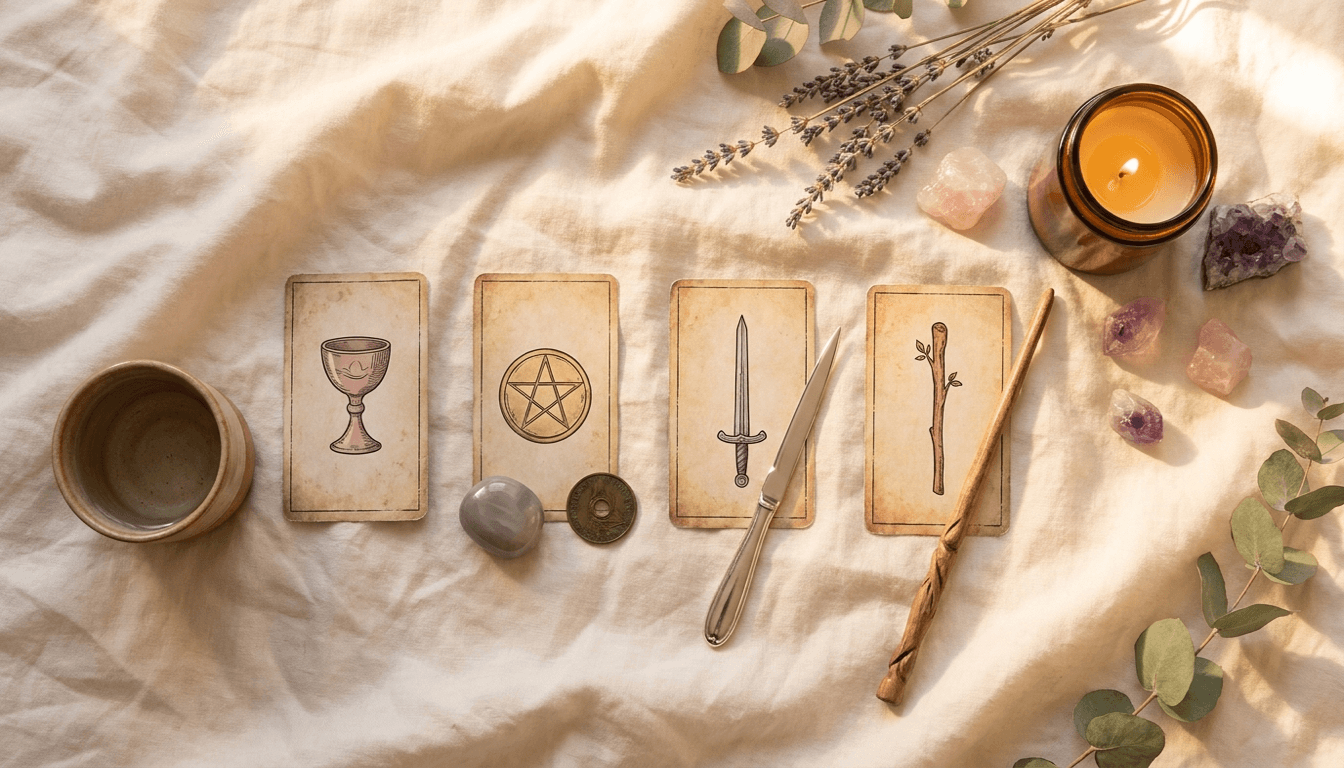
Marseille or Rider-Waite Tarot: which deck to choose
July 27, 2026 · 9 min read
Hi, what a joy to have you here.
If you've decided to buy your first deck and fell into that research rabbit hole where everyone has a different opinion — take a breath. I'm going to help you choose.
Marseille and Rider-Waite are the two most used decks in the world. Both are wonderful. But they ask different things from you, and that's what people rarely explain properly.
I'm going to tell you the real difference, without technical jargon, and in the end you'll know which one matches where you're at right now.
The difference that really matters
I'll get straight to the point, because this is the piece of information that clears up 90% of the doubt:
The difference lies in the Minor Arcana.
In both decks, the 22 Major Arcana are illustrated with rich, symbolic scenes. So there, they are quite similar.
But in the 56 Minor cards:
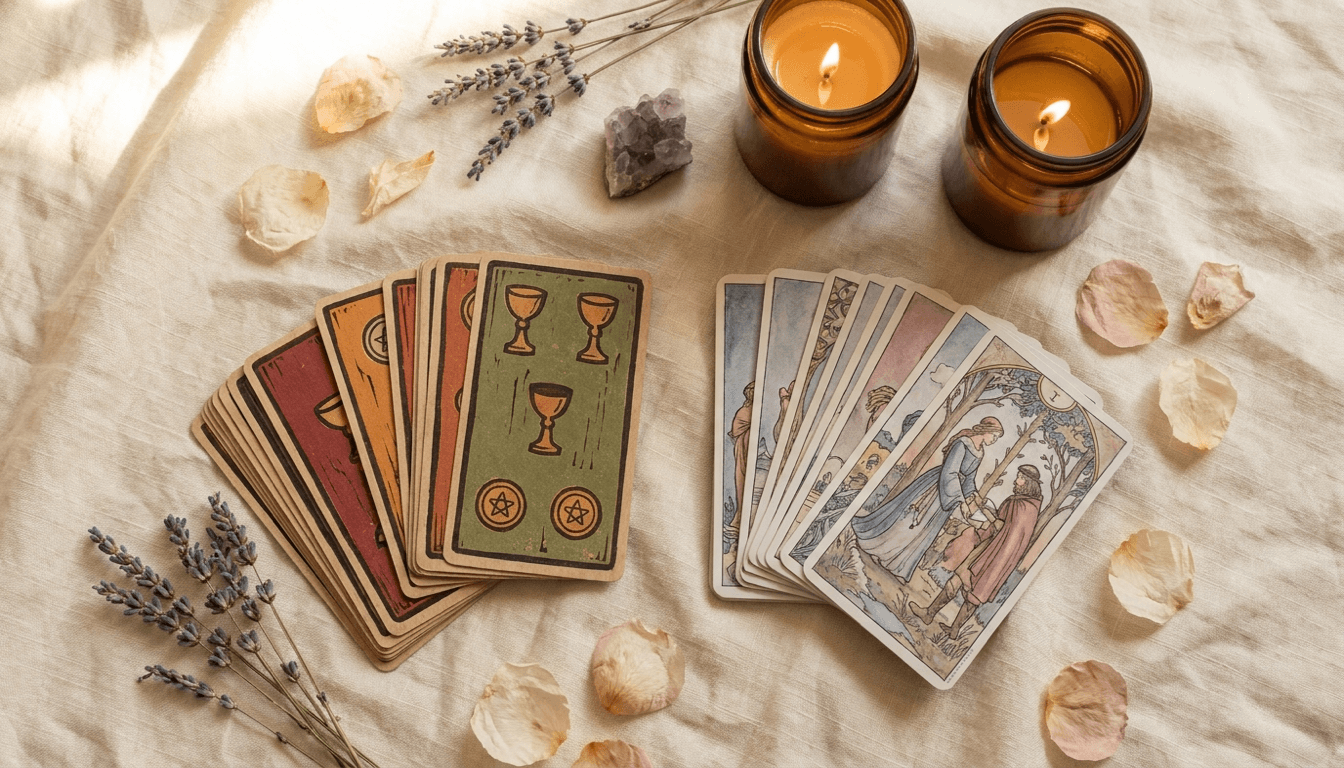
- In Marseille, cards 1 to 10 show only the repeated suit symbols. The 5 of Swords is literally five drawn swords. No scene, no character, no visual story.
- In Rider-Waite, each of these cards has a complete scene. The 5 of Swords shows someone gathering swords while others walk away defeated. The image already tells you what is happening.
That alone changes the whole learning experience. And that's why the answer to "which one is better" depends entirely on how you want to read.
Marseille Tarot: the tradition
Marseille is much older. It established itself in France around the 17th century, originating from European playing cards that gradually acquired divinatory use.
It has a striking aesthetic: flat colors, a somewhat rustic line, that old woodcut look. It's beautiful in a raw way.
How Marseille is read: since the Minor Arcana don't have scenes, the reading relies on numerology (what the number 5 means in any suit) combined with the element of the suit. You build the meaning from these two pieces, not from the image.
This requires more study at first. But those who connect well with Marseille usually say that the reading feels cleaner, less influenced by someone else's illustration.
Rider-Waite: the most widely used in the world
The Rider-Waite-Smith was published in 1909 in England. It was conceived by Arthur Edward Waite and — this is important and almost always forgotten — illustrated by Pamela Colman Smith, an artist who for decades didn't receive the credit she deserved.
It was her idea that changed tarot forever: illustrating all 78 cards with narrative scenes.
How Rider-Waite is read: through the image. The scene already gives you the mood, the characters, the direction of the gaze, the symbolic details. You can intuit a lot even before opening a single book.
That's why most courses, apps, and books use this deck as their foundation. And that's also why it's usually the most recommended for beginners.
Which one to choose to get started?
If you want my honest recommendation for someone starting out: start with Rider-Waite.
Not because Marseille is inferior — it isn't. But because at the beginning we need welcoming ease, not obstacles. When the card shows you a scene, you have a doorway in. When it shows you five swords in a row, you already need to know a lot to make sense of it.
And there's another very practical aspect: almost all study material available today uses Rider-Waite as a reference. Learning with it means having more company along the way.
Consider Marseille if: you already have some familiarity with tarot, like numerology, feel drawn to historical tradition, or want a reading that is less guided by someone else's illustration.
What about the other decks I see out there?
There are hundreds — Thoth, Lenormand, and an infinity of gorgeous indie decks.
My advice: pick one and stick with it for a while before starting a collection. Your relationship with a deck deepens over time. Switching all the time is like starting a new friendship every week and never letting any of them mature.
One criterion that is worth more than all the others
After all this technical explanation, I need to tell you what really matters:
Choose the deck that calls to you.
Seriously. If you looked at a deck and felt that sweet spark, that urge to hold it in your hands — go for it. The connection you build with the imagery matters far more than any argument about tradition or teaching methods.
Tarot is a symbolic language, and symbols work through resonance. If the images don't touch you, no technique can compensate for that.
If you'd like to better understand the structure of the cards before deciding, I wrote a comprehensive guide on the Major and Minor Arcana of tarot.
Taking care of your deck
Regardless of what you choose, here are a few gentle suggestions:
- Store it with intention. A cloth pouch, a small box. It doesn't need to be expensive, it just needs to be cared for.
- Handle it before using. Shuffle slowly, feel the cards. This isn't superstition; it's presence.
- Let it rest. A few days without pulling cards does a world of good — for you and for your relationship with the deck.
Want to learn with me?
If you're starting out and want someone to walk alongside you, I would love to accompany you on this journey of discovery.
I work with Therapeutic Tarot 100% online, in a warm, judgment-free space — whether for a reading or to help you understand how the cards can become a self-knowledge tool in your daily life.
Let's talk on WhatsApp — tell me where you are on your journey. I'm waiting for you with love. 🌙
With love,
Cris — Fox Terapias Holísticas
Frequently Asked Questions
What is the main difference between Marseille Tarot and Rider-Waite?
It lies in the Minor Arcana. In Marseille, cards 1 to 10 show only the repeated suit symbols. In Rider-Waite, each card features a fully illustrated scene, which makes intuitive reading much easier.
Which deck is best for beginners?
I usually recommend Rider-Waite. The illustrated scenes give you a doorway in even without prior study, and most books, courses, and resources use this deck as a reference — so you have more company along the way.
Is Marseille Tarot harder?
It requires more study at first because reading the Minor Arcana relies on numerology and the element of the suit, rather than the image. It's not harder in a negative way — it's a different path, which many people find cleaner once they get used to it.
Can I have more than one deck?
Of course you can. But I suggest choosing one and spending time with it before collecting. Your relationship with the cards deepens through shared time — switching all the time doesn't let any friendship mature.
Ready to start your healing journey?
Come talk to me, no strings attached. I'll welcome you with all my care and explain what your session can be like.
As terapias holísticas são um apoio ao seu bem-estar e não substituem acompanhamento médico, psicológico ou psiquiátrico. Em caso de sofrimento intenso, procure um profissional de saúde.