Tarot Arcana: the complete guide to the Major and Minor
July 26, 2026 · 11 min read
Hi, so good to have you here.
If you've ever looked at a tarot deck and felt that blend of enchantment and "my goodness, that's way too many cards" — I completely understand. It was exactly like that for me in the beginning.
There are 78 cards. It seems like a lot. But when you realize that they are organized into two main groups, everything becomes simpler. And more beautiful too, because this division isn't bureaucratic — it tells a story about how life unfolds.
Come with me. I'll introduce you to the Arcana gently, just the way I like: no rote memorization, no heavy mysticism, just us talking about what these cards have to say about you.
What does the word "arcana" mean?
First of all, it's worth unpacking the word. "Arcanum" comes from the Latin arcanum, which means secret, mystery, that which is kept hidden.
But pay attention, because here lies a common point of confusion: it's not a secret that the cards are hiding from you. It's a secret that lives inside you, which the card helps bring to light.
This difference changes everything. The cards don't hold information about your future — they offer an image, a symbol, and what is revealed is what was already there, waiting to be looked at.
How many cards are in tarot?
The traditional deck has 78 cards, divided like this:
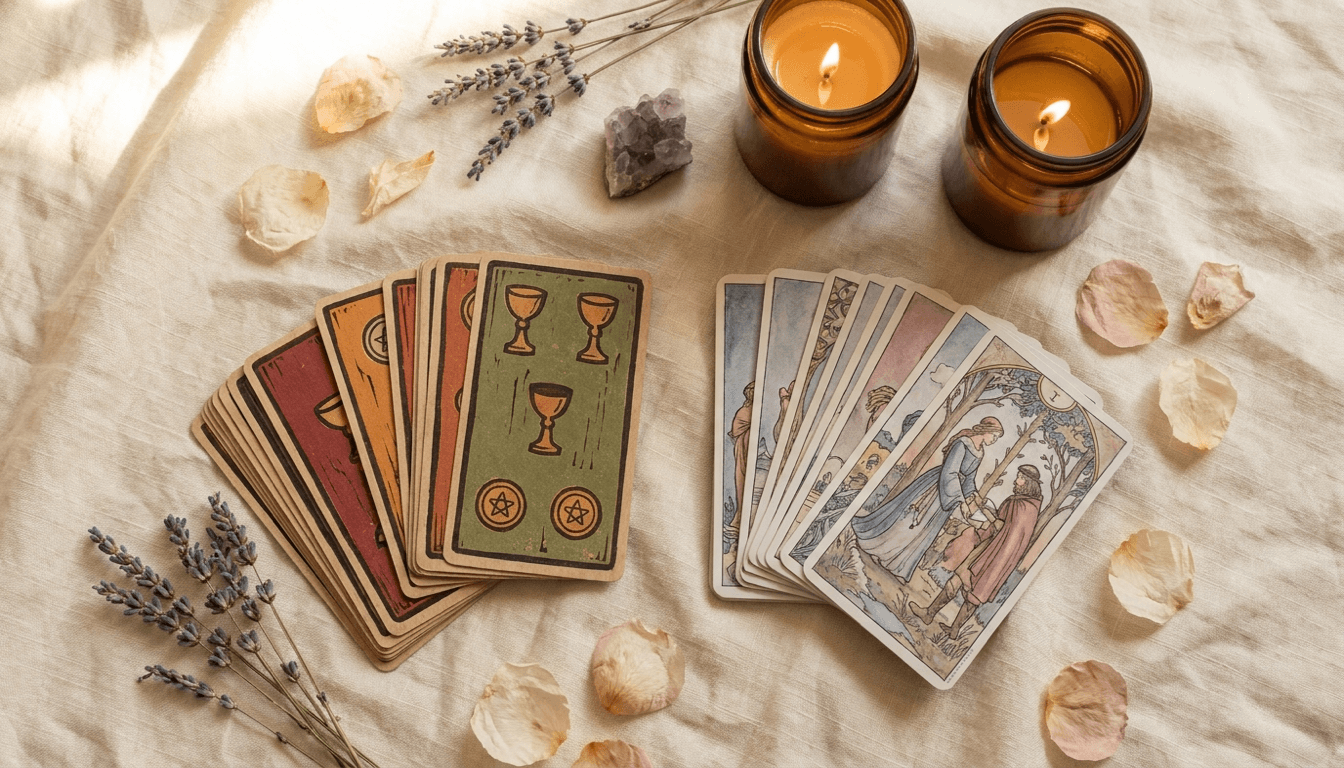
- 22 Major Arcana — the big life lessons, the cycles, the turning points.
- 56 Minor Arcana — the day-to-day life, small choices, the ground of everyday living.
I like to explain it this way to people who have a session with me for the first time: if your life were a book, the Major Arcana would be the chapter titles. The Minor Arcana would be the scenes within each chapter.
Both matter. One without the other tells only half the story.
The 22 Major Arcana: the journey of the soul
The Major Arcana are numbered from 0 to 21, and do not belong to any suit. Each one is unique — it doesn't repeat, and has no similar sibling in another group.
They begin with The Fool (0), who sets off without really knowing where he is going, with an open heart and a knapsack over his shoulder. And they end in The World (21), the feeling of completeness, of a cycle that closes whole.
Between one and the other lies everything we go through: the learning, the love, the loss, the strength we didn't know we had, the time to turn the page.
This sequence has a beautiful name: the Fool's Journey. It is the journey of a soul from the beginning to the end of a cycle — and that's why the Major Arcana touch us so deeply. They speak of archetypes, of those universal figures that exist in every human story.
Some Major Arcana and what they bring
- The Empress (III) — creation, care, the abundance that springs from within. Fertility in every sense, not just literal.
- Strength (XI) — not brute force, but gentle courage. The kind that tames the lion with tenderness, not blows.
- Death (XIII) — and here I need to reassure you: this card almost never speaks of physical death. It speaks of the end of a cycle, of transformation, of what needs to end so something else can be born.
- The Star (XVII) — the hope that returns after the storm. One of the sweetest cards in the deck.
When a Major Arcana appears in a reading, I usually slow down. It's a sign that there's a bigger lesson there, something that truly asks for attention — not a passing issue.
The 56 Minor Arcana: life happening
The Minor Arcana are organized into four suits, each linked to an element and an area of our experience. If you already know a little about astrology or energy therapies, you'll recognize this logic right away.
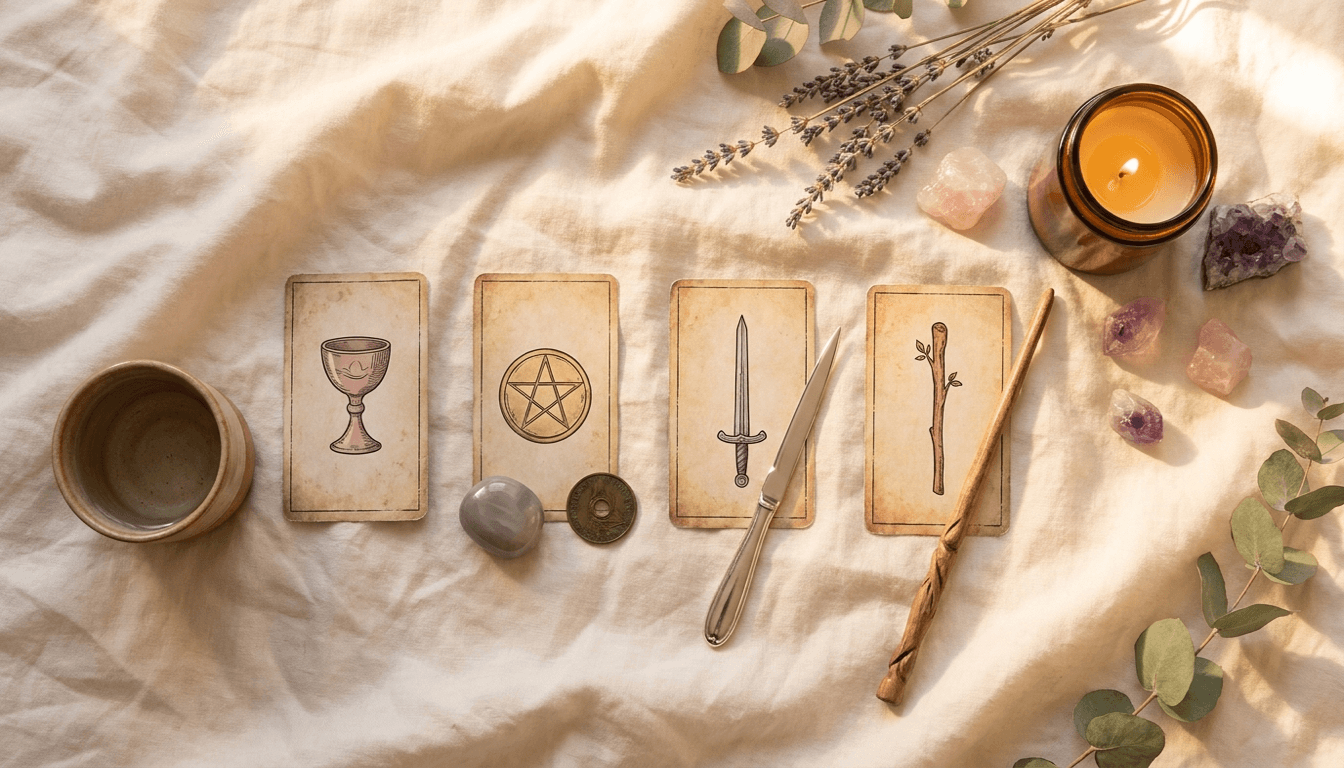
- Cups — Water. Emotions, affections, relationships, intuition. It's the suit of the heart.
- Pentacles — Earth. Body, work, money, home, the material world. The suit of the ground beneath us.
- Swords — Air. Thought, communication, conflicts, difficult truths. The suit of the mind.
- Wands — Fire. Action, desire, creativity, courage. The suit of impulse.
Each suit has 14 cards: from Ace to 10, plus four court cards (Page, Knight, Queen, and King).
The numbered cards tell the evolution of a situation — the Ace is the seed, the 10 is the full unfolding. The court cards usually represent people, or attitudes we adopt towards life.
What is the difference between Major and Minor Arcana?
This is the question I get asked the most, so I'll answer directly:
- Weight. Major speak of cycles and grand destiny. Minor speak of daily life, of what is in motion right now.
- Time. Major tend to point to longer processes. Minor, to more immediate situations.
- Structure. Major are unique and do not repeat. Minor follow a logic of suit and number, creating patterns and repetitions.
- Reach. Major say "look, this is about your soul." Minor say "look, this is about your week."
But I need to tell you something I rarely see written anywhere: this hierarchy isn't rigid.
I've seen a 5 of Cups — a "minor" card — touch someone far deeper than any Major Arcana in that session. Because that image of someone looking at spilled cups, without seeing the ones still standing, was exactly that person's life at that moment.
The right card is the one that touches you. Not the one with the prettier number.
How the two converse in a reading
In practice, both groups work together, and that's when the reading gets interesting.
If many Major Arcana appear in a spread, it's usually a sign that the person is at a turning point — something foundational is happening, even if they haven't put a name to it yet.
If Minor Arcana predominate, it tends to be a period of management rather than transformation: practical choices, adjustments, life in its ordinary rhythm.
And when a Major card appears surrounded by Minors? Then I read it as a big theme manifesting in small details. The lesson is happening in the everyday details of life.
Do I need to memorize all 78 cards?
No. And please, don't try to.
Memorizing meanings is the fastest way for a reading to become stiff, mechanical, lifeless. I prefer to invite you to do something else: look at the image before searching for the meaning.
What do you feel when looking at that card? Which part of the scene calls to you? Is the person in the picture looking forward or backward? Is there water, fire, someone alone or accompanied?
Tarot symbolism was built to speak to the unconscious mind. It works best when we let the image arrive first and the explanation follow after.
Where the Arcana come into therapeutic tarot
In the work I do, the Arcana are not used to predict anything. They are a mirror.
When a card appears, my question is never "what is going to happen." It's "what does this awaken in you?". And it's incredible how the answer was almost always already there, just needing a symbol to give it shape.
The Major Arcana usually open up conversations about purpose, about cycles that person knows they need to close. The Minor Arcana bring the concrete: that difficult conversation, that stalled project, that heavy feeling.
If you'd like to better understand this approach, I wrote about it thoughtfully in what Therapeutic Tarot is (and why it isn't fortune-telling).
Shall we walk this path together?
If reading this made you want to look at your own journey with the help of the cards, I would love to accompany you.
I offer 100% online sessions, in a safe and judgment-free space. We sit together, look at whichever cards come up, and talk about what they awaken in you. No predictions, no scares — just self-knowledge at your own pace.
Let's chat on WhatsApp — tell me what is calling to you, and we'll see the best path for you. No obligation, with an open heart. 🌙
With love,
Cris — Fox Terapias Holísticas
Frequently Asked Questions
How many arcana are in the tarot?
The traditional deck has 78 cards: 22 Major Arcana (numbered from 0 to 21) and 56 Minor Arcana, divided into four suits of 14 cards each — Cups, Pentacles, Swords, and Wands.
Are the Major Arcana more important than the Minor?
They tend to carry more weight in a reading because they speak of life cycles and lessons. But I avoid this rigid hierarchy: I've seen 'minor' cards touch someone far deeper. The right card is the one that speaks to you at that moment.
Can I read tarot using only the Major Arcana?
Yes, you can, and many people start this way. It's a way to get familiar with the archetypes without feeling overwhelmed. Just know that you will catch the big themes, but miss the everyday details that the Minor Arcana bring.
Does the Death card mean someone is going to die?
No. That is probably the biggest misconception about tarot. Arcana XIII speaks of the end of a cycle and transformation — something that needs to conclude so that something else can be born. In practical readings, it almost never has anything to do with physical death.
Ready to start your healing journey?
Come talk to me, no strings attached. I'll welcome you with all my care and explain what your session can be like.
As terapias holísticas são um apoio ao seu bem-estar e não substituem acompanhamento médico, psicológico ou psiquiátrico. Em caso de sofrimento intenso, procure um profissional de saúde.